
When booking an LTL shipment, accurate information about the consignee and delivery location is important.
LTL deliveries often require more planning than parcel deliveries because the carrier may need specific equipment, access instructions, appointments, or other services to complete the delivery.
Providing these details when you create the shipment can help reduce delays, failed delivery attempts, and unexpected accessorial charges.
Confirm the receiving location
Before booking, confirm what equipment and access are available at the delivery location.
Loading dock
Determine whether the consignee has a loading dock that can receive an LTL trailer.
If there is no loading dock, a liftgate or tailgate service may be required, depending on the freight and the equipment available at the location. LTL carriers commonly treat liftgate service as an additional accessorial service.
Unloading equipment
Confirm whether the consignee has suitable equipment to unload the freight, such as:
- a forklift
- dock-level material-handling equipment
- other equipment appropriate for the shipment
A pallet jack can help move palletized freight once it is accessible, but it does not necessarily eliminate the need for a liftgate when freight must be lowered from the trailer to ground level.
Vehicle access
Some delivery locations cannot accommodate a full-size tractor-trailer.
Examples can include:
- narrow streets
- residential areas
- construction sites
- locations with restricted entrances
- properties with limited turning space
If the location requires a smaller vehicle or has limited access, select the applicable service during booking when available and include clear details in Special Instructions.
Additional charges may apply for limited-access or specialized delivery requirements.
When should I select Liftgate or Tailgate service?
Select Liftgate/Tailgate when the consignee cannot safely unload the freight directly from trailer height using the equipment available at the location.
This is commonly needed when:
- there is no loading dock
- suitable unloading equipment is not available
- the shipment is being delivered to a residential or other non-dock location
If liftgate service is required but was not included when the shipment was booked, the carrier may apply an additional charge or may need to reschedule the delivery with the appropriate equipment.
Confirm appointment and notification requirements
Ask the consignee whether they require:
- a delivery appointment
- advance notification
- a call before delivery
- delivery within specific receiving hours
These services may be treated as accessorial services and may result in additional charges depending on the carrier.
For example, FedEx Freight lists Notification Prior to Delivery as an additional service, while Estes lists notification and scheduled appointments as an accessorial service.
Do not assume that a request for a phone call and a scheduled appointment are handled the same way by every carrier.
Provide accurate receiving hours
If the consignee can only receive freight during specific hours, provide those details when booking.
For example:
Receiving hours: Monday–Friday, 8:00 a.m.–3:00 p.m.
Also note closures, lunch periods, security restrictions, or other circumstances that could prevent the driver from completing delivery.
Include required PO or reference numbers
If the consignee requires a purchase order, reference number, delivery number, or other identifier before they can accept the freight, include it when creating the shipment.
Missing information can prevent the consignee from accepting delivery and may lead to a redelivery attempt.
Provide reliable consignee contact information
Include accurate contact information whenever possible:
- consignee or business name
- direct phone number
- email address
- appropriate receiving contact
The carrier may need this information to arrange an appointment, confirm delivery details, or resolve an issue before attempting delivery.
Can storage, detention, or redelivery charges apply?
Yes. LTL carriers may apply additional charges when freight cannot be delivered as planned.
Storage
If delivery cannot be completed and the freight remains at the carrier’s terminal, storage charges may apply after the carrier’s applicable free-storage period.
The amount of free time and the storage charges vary by carrier and tariff, so there is no universal 24- or 48-hour rule.
Detention
Detention or waiting-time charges may apply when the driver is required to wait beyond the carrier’s allowed free time while loading or unloading.
Free time and detention rates vary by carrier. FedEx Freight, for example, publishes detention as a separate accessorial charge.
Redelivery
If the carrier attempts delivery but cannot complete it, a redelivery charge may apply.
Carriers such as FedEx Freight specifically list redelivery as a chargeable additional service.
What information should I include when booking?
Before completing an LTL shipment, confirm:
- full consignee name and delivery address
- phone number and email address
- receiving hours
- loading dock availability
- whether liftgate/tailgate service is required
- available unloading equipment
- limited-access or smaller-vehicle requirements
- appointment or notification requirements
- required PO or reference numbers
- clear commodity and shipment details
- any other special delivery instructions
Use the ShipTime BOL and shipping labels
For LTL shipments booked through ShipTime, use the Bill of Lading (BOL) and shipping labels generated by ShipTime, unless you are specifically instructed otherwise.
Using different documentation can result in incorrect billing information, tracking issues, or charges that do not match the shipment booked through ShipTime.
Make sure the BOL accurately reflects the services and delivery requirements selected when the shipment was created.
Select all applicable LTL requirements in ShipTime
When creating an LTL shipment, review the available options in the LTL section and select all services that apply to the pickup and delivery.
This can include requirements such as:
- liftgate/tailgate
- residential or limited-access service
- delivery appointment
- notification
- other applicable accessorial services
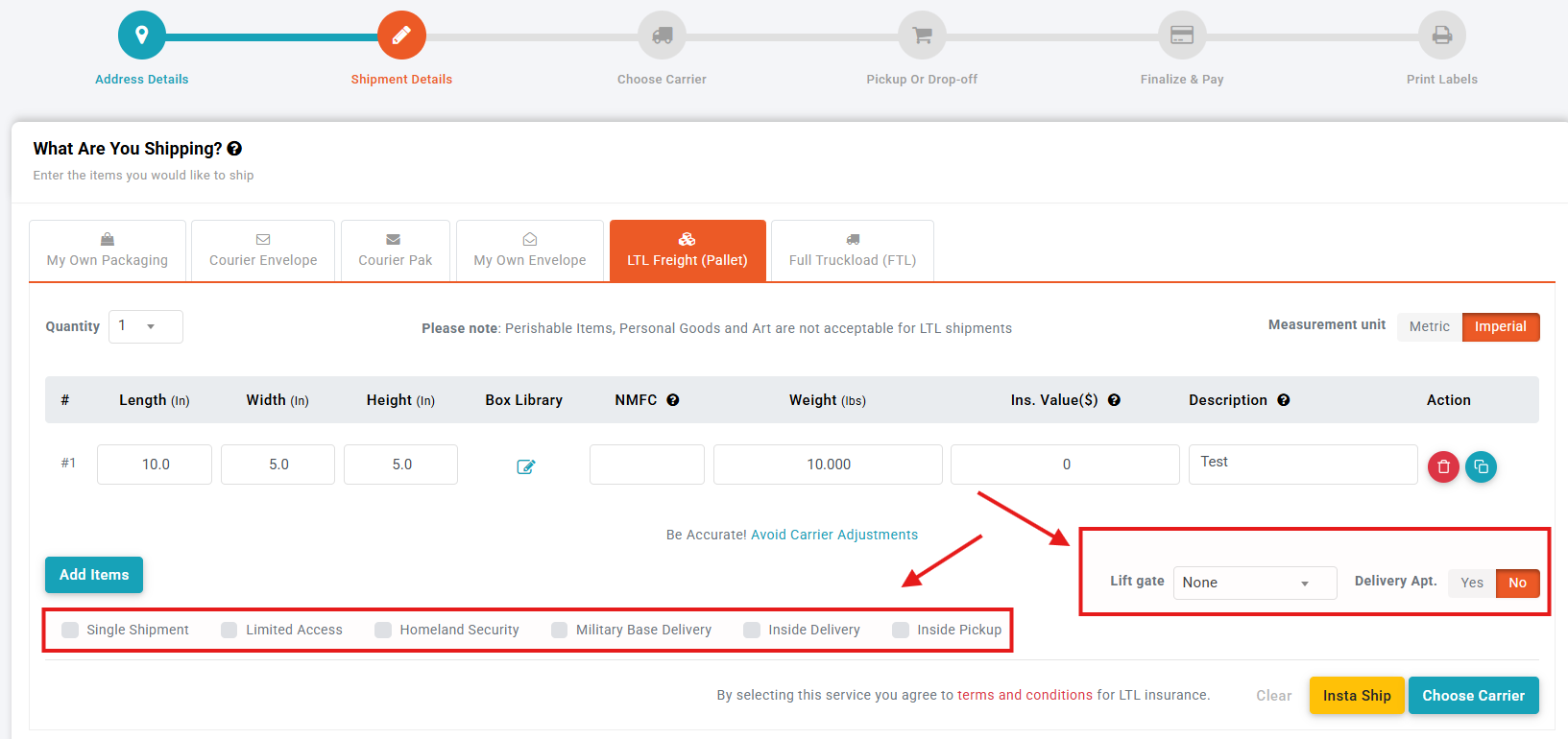
Selecting the required services when booking helps ensure the carrier receives the appropriate instructions and equipment requirements.
If an additional service is required but was not selected during booking, the carrier may apply an adjustment or additional accessorial charge afterward. Day & Ross, for example, notes that additional services such as tailgate, limited access, and appointments may result in accessorial charges.
LTL delivery checklist
Before booking your shipment:
- confirm whether there is a loading dock
- determine whether liftgate/tailgate service is needed
- confirm the available unloading equipment
- check for limited vehicle access
- confirm receiving hours
- determine whether an appointment or notification is required
- provide accurate phone and email contact information
- include any required PO or reference numbers
- select all applicable LTL services in ShipTime
- use the ShipTime-generated BOL and labels
- include clear Special Instructions for any unusual delivery requirements
If you’re unsure which LTL delivery services to select, contact our Heroic Support™ team before completing the shipment and we can help review the delivery requirements.
Not using ShipTime yet? Create your free ShipTime account to access discounted rates from leading couriers, all in one platform.